Table legs do more than support a tabletop. They determine the finished height, visual weight, stance, stability, and overall style of the piece. The right wood table legs can turn a simple slab into a finished dining table, give a desk the correct working height, or help a bench feel balanced and intentional in the room.
At Design 59, we approach table legs as true furniture components, not generic replacement parts. A well-chosen leg has to work with the thickness of the top, the mounting method, the weight of the build, the finish plan, and the way the table will be used every day. Whether you are building a farmhouse dining table, updating an existing piece, making a bench, or completing a custom desk, the leg choice affects both the appearance and the performance of the finished furniture.
How to Choose Wood Table Legs for Your Project
The best table leg choice starts with function before style. A chunky farmhouse leg, a modern square leg, and a turned pedestal-style post can all look good in a product photo, but they serve different purposes in a finished build.
The four most important specifications are height, style, wood species, and mounting method. Once those are correct, finishing becomes the final step.
Table Leg Height
Start by deciding the finished height of the table, then subtract the thickness of your tabletop. Most builders use a tabletop thickness between 0.75″ and 1.25″ when calculating final height.
Common table leg heights include:
Dining tables: 28″–30″ leg height, with 29″ being the most common
Counter-height tables and kitchen islands: 34″–36″ leg height
Bar-height tables: 40″–42″ leg height
Coffee tables: 14″–18″ leg height, with 16″ being common
Benches: 16″–18″ leg height
Console and sofa tables: 28″–32″ leg height
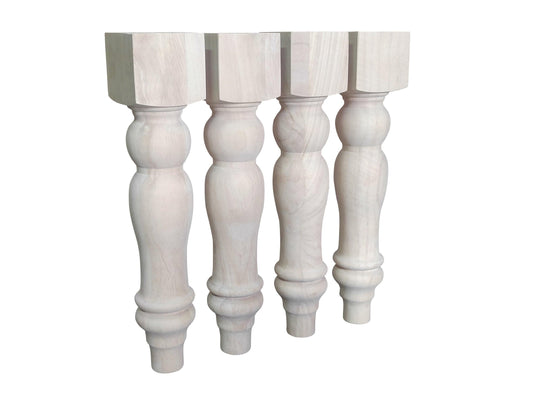
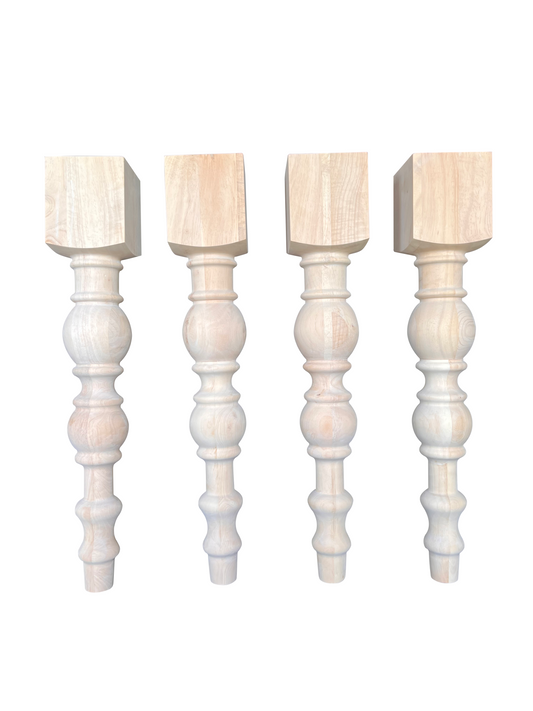
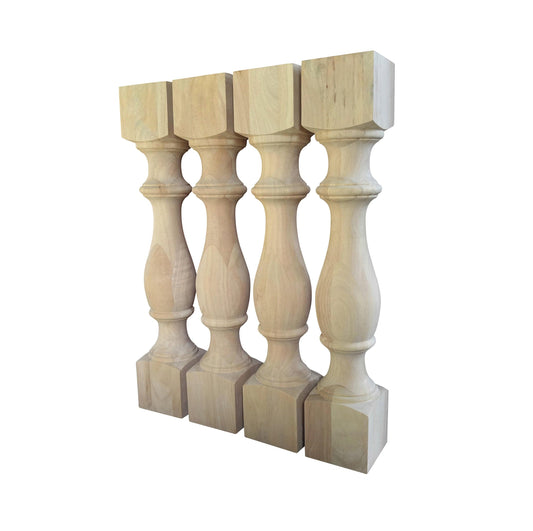
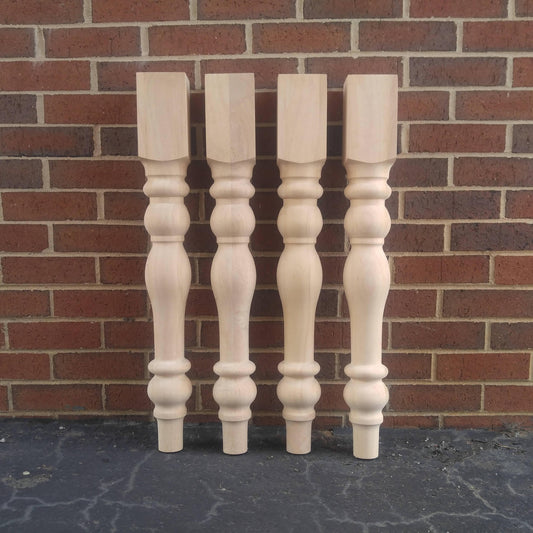
For standard dining-height builds, Design 59’s 29″ Monastery legs and F3 Modern Farmhouse Turned legs are proportioned for typical dining tables. The 18″ B2 set works well for benches and slightly taller coffee tables.
Table Leg Style
Style has the biggest impact on how the finished piece reads visually. A table leg can make the same tabletop feel rustic, traditional, modern farmhouse, cottage-inspired, or clean and contemporary.
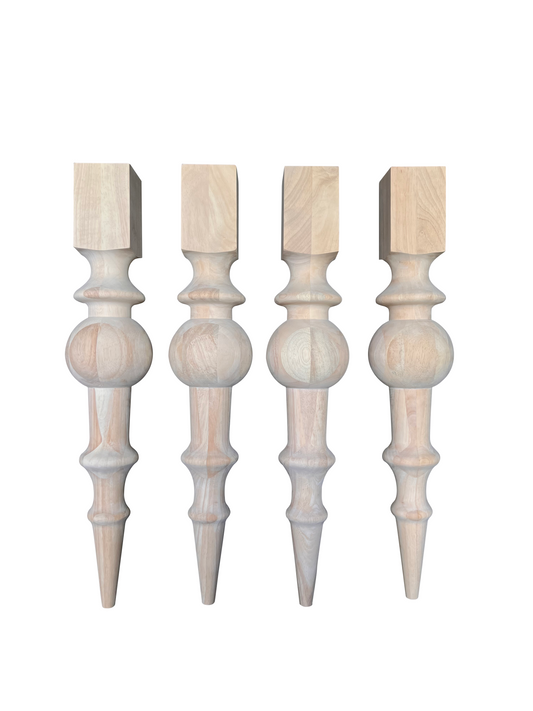
Most of this collection focuses on turned hardwood table legs, which remain one of the most popular choices for farmhouse, traditional, and transitional furniture builds. Design 59 also offers select chunky, modern, and simplified profiles for cleaner interiors.
Chunky farmhouse turned legs have heavier proportions, deeper turnings, and a rustic-traditional look. The F1 Chunky Farmhouse leg is one of the most popular choices in this profile.
Cottage farmhouse turned legs have a slimmer silhouette with traditional ring detailing. The F2 Cottage Farmhouse leg fits well in lighter farmhouse, cottage, and casual dining spaces.
Modern farmhouse legs use cleaner turning details and a more restrained profile. The F9 Modern Farmhouse and F3 Modern Farmhouse Turned legs work well in transitional rooms where the furniture needs farmhouse character without looking overly rustic.
Monastery-style turned legs are taller, heavier, and more traditional, with lathed bands near the cap and base. The F4 Monastery leg gives dining tables a substantial, grounded appearance.
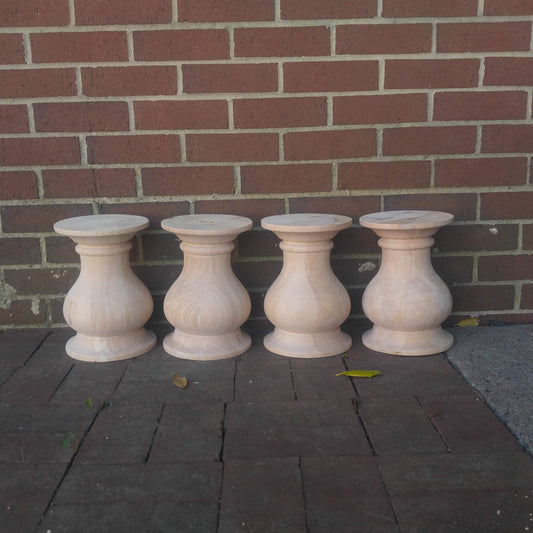
Balustrade-style legs use stacked turnings inspired by porch and stair balusters. These are best suited for heavier rustic coffee tables, end tables, and accent furniture.
Wood Species: Parawood vs. Pine
Wood species affects weight, finishing behavior, durability, and the overall quality of the finished piece. This collection primarily uses Parawood and pine.
Parawood Table Legs
Parawood is a tight-grained hardwood with density in the approximate range of 37–43 lb/ft³. It machines cleanly, holds turned details well, and accepts stain more evenly than many softwoods. For furniture builders, professional shops, and advanced DIY projects, Parawood provides a more refined finished result.
Parawood is a strong choice for dining tables, desks, benches, and furniture pieces where the finished look matters. Its weight, density, and finish behavior are closer to traditional furniture-grade hardwoods than to economy softwoods.
Pine Table Legs
Pine is a softer, lighter wood with density around 28–35 lb/ft³. Knotty pine has more visible grain variation and is especially well suited for painted finishes. It is a practical choice for entry-level builds, rustic projects, and furniture where a painted finish is planned.
For stained finishes, pine typically requires more prep. Knots and grain variation can show through unless the wood is sealed or conditioned properly before finishing.
Mounting Wood Table Legs
Most table builds use one of three common mounting methods: top plates with hanger bolts, pocket screws, or mortise-and-tenon joinery.
Pocket Screw Attachment
Pocket screws are commonly used when the table includes an apron or skirt rail. The screws are driven through the apron and into the leg, creating a clean and practical connection without specialty hardware. This is one of the easiest methods for DIY builders working with traditional table aprons.
Mortise-and-Tenon Joinery
Mortise-and-tenon joinery is the strongest and most traditional method. A mortise is cut into the table leg, and a matching tenon is cut on the apron rail. The joint is then glued and clamped. This method is ideal for heirloom dining tables, contract furniture, and heavy-use pieces expected to last for decades.
Mounting hardware is not included with most table leg sets and is not required for every build. Pocket screw and mortise-and-tenon construction are determined by the tabletop and apron design. If you prefer top-plate mounting, plates and hanger bolts can be sourced separately from most hardware suppliers.
Finishing Unfinished Wood Table Legs
Every table leg in this collection ships unfinished, giving you control over the final color, sheen, and protective topcoat.
For best results, sand the legs to 220 grit before applying finish. Many legs arrive close to finish-ready, but one final sanding pass helps even out the surface and prepare the wood for stain, paint, or clear coat. After sanding, wipe away dust with a tack cloth.
For stained finishes, a pre-stain conditioner is recommended, especially on turned details and exposed end grain where absorption can vary. Parawood stains more evenly than many softwoods, but proper prep still improves the final result.
For professional furniture builds, lacquer is often the best topcoat. It sprays evenly, builds quickly, dries hard, and produces the clean furniture-grade finish expected on resale, contract, and high-end custom work. Wipe-on polyurethane and hardwax oil are also acceptable for hand-finished projects where spray equipment is not available.
For painted finishes, prime first. Knotty pine should be sealed with a shellac-based primer to help block knot bleed and tannin discoloration. After priming, apply two finish coats for a clean, durable painted surface.
Why Trust Design 59 for Table Legs?
Design 59 has been working with furniture components, upholstery materials, and home furnishings since 2015. We look at table legs the way furniture people do: by proportion, wood character, shape, finish readiness, mounting method, and how the finished piece will actually look in a room.
Our table legs are used for dining tables, benches, desks, coffee tables, repairs, and DIY furniture projects. Every project is a little different, so the details matter. The right leg depends on the finished height you want, the thickness of your tabletop, the mounting setup, the style of the room, and the overall scale of the piece.
Over the years, Design 59 has completed more than 150,000 marketplace sales and earned over 5,000 verified 5-star marketplace reviews. That experience has taught us what customers care about most: accurate dimensions, clear photos, dependable shipping, and products that work for real furniture builds.
Design 59 is a furniture-focused source for table legs, ottomans, upholstery supplies, pillow covers, dog beds, and other home furnishing products. Our goal is to make it easier to choose parts that not only fit the project, but also look right once the piece is finished.
Before choosing table legs, start with the basics: finished height, tabletop thickness, mounting method, and room style. Getting those right first prevents most common project mistakes.